
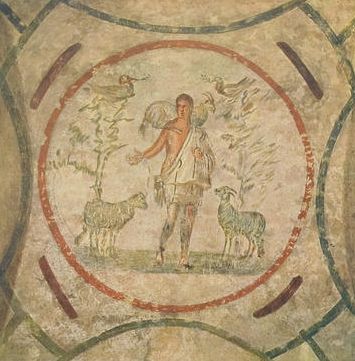
 In the first few centuries after the death of Jesus, there was much debate in the nascent Christian community on whether or not imagery should have a place within Christian worship (Mullett). These internal deliberations, coupled with the growing tensions between Christians and the Roman pagan majority of the empire, meant that for many early Christians, visual manifestations of their faith was not standard practice. It is to this period before 313 CE, that most scholars point to when discussing the first emergence of identifiable Christian art (Mullett). Often cited as “pagan in style and Christian in subject”, the Christian art from this era is largely symbolic and appropriative of pagan motifs- so that often it is only the context of the work, which allows it to be identified as Christian (Hood 5) (Stokstad 16). Yet, several extant examples show the beginnings of the vibrant visual culture that would eventually develop and evolve into the canon of Christian art which we know today. One such example can be found in The Good Shepherd fresco which decorated the domed ceiling of the Priscilla Catacomb in Rome. Pulling from Classical motifs, The Good Shepherd is presented with the stylistic tenants of Late Antiquity, yet also works to showcase the incipient symbolism that was developing for the newly emergent religion, by creating images which contemporary Romans and newly converted Christians could relate to.
1 Comment
The Cultural Significance of The Calling of St. Matthew by Michelangelo Merisi da Caravaggio10/24/2015  When Michelangelo Merisi da Caravaggio completed the painting The Calling of St. Matthew in July 1600 he did so in the culture of the Counter Reformation, with a Catholic Church that sought to reach out to its parishioners through art. Throwing aside the conventions of the Renaissance and creating his own, Caravaggio worked to fulfill this mission with a realism, immediacy and a flair for the dramatic that sometimes was off putting to those around him. Yet the profound effect of his work cannot be denied and the ways in which he created would change the face of the art world. 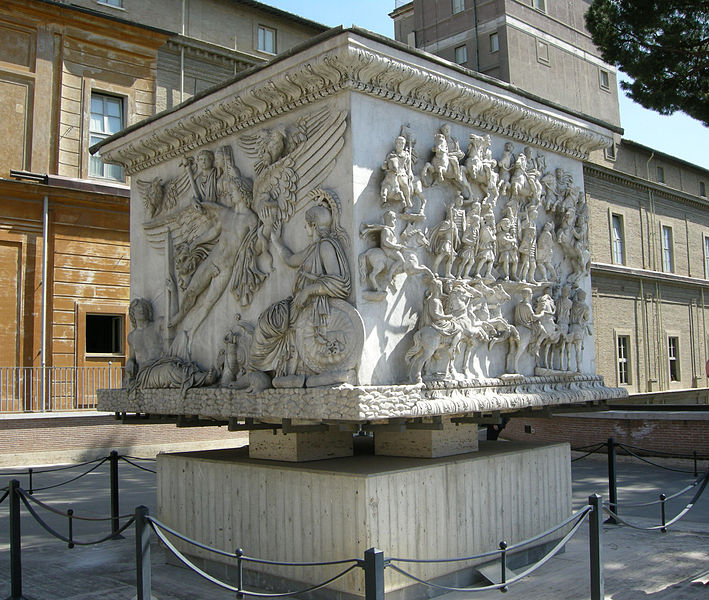 Photo by Sailko Within the history of Imperial Rome, the time period dating from 96 C.E. to 180 C.E. is known as the age of the “Five Good Emperors” in honor of those that presided over the empire in that time: Nerva, Trajan, Hadrian, Antoninus Pius and Marcus Aurelius. It was a time of distinction where trade flourished and the previous held prejudices between Italian born Romans and Romans originating from the outer provinces of the empire lessened as provincials took more positions of power. People were no longer constricted to positions based on lineage but on ability and experience, even the emperors themselves. In 138 C.E. Antoninus Pius, a tried and true politician, was adopted by Emperor Hadrian at the age of 51. Furthermore Antoninus went out and adopted Marcus Aurelius and Lucius Veras assuring a clean succession. During his reign, Antonius Prius restored the Senate without weakening his own imperial power and generally ruled with merit. Upon his death in 161 C.E his two successors rose to power as the first co-emperors, and one of their first acts was to memorialize their adopted father with the Column of Antoninus Pius. |

AuthorCrystal has a MA in the History of Art from Courtauld Institute of Art as well as a BFA in Art History from the Academy of Art University. Archives
November 2017
Categories
All
|
 RSS Feed